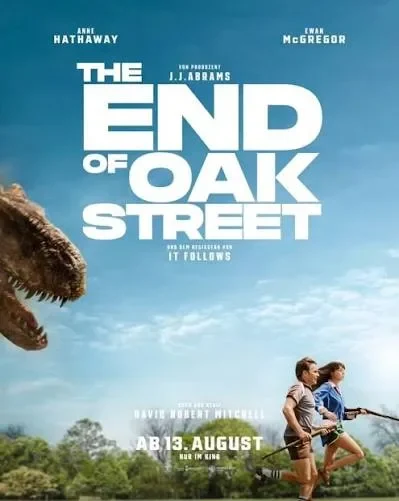
The End of Oak Street is most alive when its immaculate suburb stops behaving like a nostalgic museum piece and becomes a pressure cooker: a family adventure, creature feature and deadpan domestic comedy all fighting for the same patch of asphalt.
Spoiler-light review. The analysis discusses the premise, tone and craft without revealing the ending.
A familiar suburb with an unstable floor
David Robert Mitchell places the story in 1982, and the period setting initially invites easy comparisons with the suburban wonder of E.T. and Close Encounters. The resemblance is useful but also a trap. Mitchell is less interested in recreating innocence than in showing how quickly a carefully ordered neighborhood can become absurd when the impossible arrives. The lawns, family rooms and cul-de-sacs establish a reassuring geometry; the film's pleasure comes from watching that geometry fail. Its monsters do not merely interrupt domestic life. They expose how fragile the adults' sense of control always was.
The genre collision is the point
The film keeps changing the rules of its own evening. Awe gives way to panic, panic to slapstick, and slapstick to passages of genuine peril. That volatility produces the movie's best charge. A giant creature invading a house can be frightening and ridiculous in the same beat, and Mitchell resists sanding away either response. The result is deliberately less elegant than a conventional studio adventure. Viewers who need one stable tone may find it messy; viewers willing to follow its swerves will find a blockbuster with an unusually unruly pulse.
Spectacle works because space is legible
The action is clearest when the film treats the neighborhood as a practical map rather than a digital backdrop. Doors, corridors, yards and sightlines matter, so scale has comic and suspenseful consequences. The creature set pieces build from recognizable spaces and allow the audience to understand what is being threatened. This gives the effects weight even when the concept turns gleefully excessive. The production design also avoids making 1982 a parade of brand references; objects and interiors support behavior before they announce the decade.
Family feeling without sentimental autopilot
Anne Hathaway and Ewan McGregor anchor the impossible events in the stress of adults trying to manage a household that cannot be managed. The film's emotional argument is not especially novel, but it is effective: crisis strips away the polite scripts families use to avoid saying what they need. Mitchell sometimes hurries those emotional turns because another escalation is waiting outside. Even so, the performances keep the movie from becoming a technical demonstration, and the humor often comes from exhausted recognition rather than a detachable punchline.
Where the chaos loses force
The same abundance that makes the film distinctive also keeps it from landing every idea. Its references to earlier suburban fantasies are so visible that individual images can feel inherited before Mitchell twists them. Later passages stack threat, joke and emotional resolution faster than each can breathe. Yet the movie's imperfections feel connected to its appetite. It would be tidier if it were less strange, and less memorable if it behaved like a franchise pilot.
Who should see it
This is a strong match for viewers who enjoy Amblin-era adventure but want its comfort disrupted, and for creature-feature audiences who accept comedy beside danger. It is less suitable for very young children than the nostalgic packaging might suggest, and anyone seeking rigorous hard science should look elsewhere. The film opened in US theaters on August 14, 2026; availability varies by territory and should be checked with official local listings.
Review at a glance
| Element | Assessment |
|---|---|
| Direction | Restless, playful and deliberately tonally unstable |
| Performances | Ground the spectacle in recognizable family strain |
| Design | A legible 1982 suburb built for escalating disruption |
| Reservation | Too many ideas compete in the later movement |
Verdict
The End of Oak Street does not perfect its mixture of wonder, horror and comedy, but its refusal to become a clean nostalgia product is precisely its appeal. It is a big, odd swing whose best images turn suburban safety into a temporary special effect.