
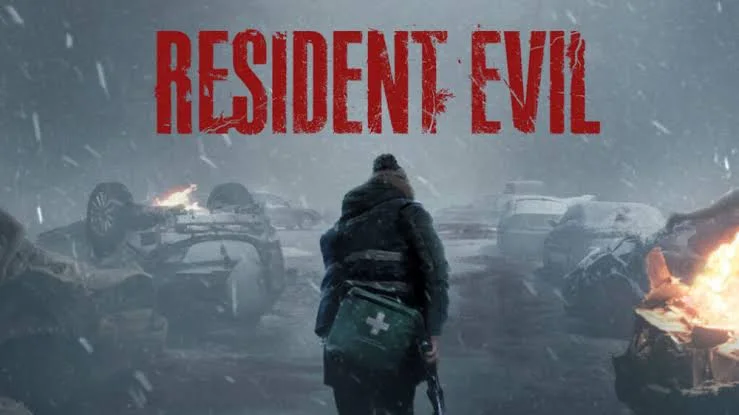
There is a moment early in Resident Evil when it becomes clear that Zach Cregger is not particularly interested in rebuilding twenty years of movie lore. He wants the simpler, nastier pleasure of being underprepared in a place where absolutely everything can kill you. That choice is the smartest thing about this reboot.
A Resident Evil movie that actually feels like survival horror
Austin Abrams plays Bryan, a medical courier whose delivery to Raccoon City General Hospital turns into a very long night. He is not introduced as an action hero waiting for permission to become cool. He looks frightened, gets overwhelmed and makes the kind of decisions a normal person might make when confronted with something that should not exist. I found that far more engaging than watching another indestructible franchise protagonist clear rooms like a professional.
Cregger builds the movie almost like a sequence of game objectives. A location is established, a problem appears, resources become scarce and Bryan has to somehow reach the next point. The camera frequently reinforces that feeling without turning the entire film into a gimmicky first-person experiment. Fans will recognize the logic of the games even when the story is doing its own thing.
The comedy is doing more work than it seems
The surprise is how funny the movie can be without dissolving the tension. Abrams has excellent panic-comedy instincts. A scream, a pause or a look of disbelief can release just enough pressure before the next ugly thing arrives. That rhythm matters because ninety minutes of relentless gore can become strangely numbing. Here, the laughs reset the room.
I also like that the film does not bury newcomers under references. There are visual nods and familiar pieces of Resident Evil DNA, but the basic proposition is wonderfully clean: one increasingly desperate man, one infected city and a route that keeps getting worse.
Where it stumbles
The forward momentum is so strong that character depth outside Bryan is inevitably limited, and the later stretch has less room to surprise once the movie has revealed the rules of its nightmare. Anyone looking for a lore-heavy adaptation of a particular game may also leave wanting a different film.
But as a piece of survival horror, this is unusually disciplined franchise filmmaking. It understands that Resident Evil is frightening not because somebody can explain the virus in detail, but because you have three bullets, a locked door and something moving on the other side of it.
Why the stripped-back approach matters
Resident Evil has accumulated enough mythology to make any adaptation nervous. There are corporations, experiments, recurring villains, mutated creatures and decades of expectations about which pieces count. This movie is much more effective when it treats that history as background pressure instead of homework. Bryan does not need to understand the architecture of the nightmare for the nightmare to work. His lack of control is the point.
That simplicity gives the horror room to breathe. A hallway can be frightening because Bryan has no good option, not because somebody has paused to explain the biological origin of whatever is waiting at the end of it. The film repeatedly chooses immediate physical problems over lore dumps, and the result feels closer to the emotional logic of survival horror: assess the room, conserve what you have and hope the next door is not worse.
Horror works better when the hero can fail
Abrams is especially useful because Bryan never seems protected by franchise destiny. He can be clever without suddenly becoming a soldier, and he can survive an encounter without making survival look easy. That vulnerability makes the violence land harder and the comedy funnier. A tiny victory can feel enormous when the person earning it looks genuinely exhausted.
The reboot does not solve every problem Resident Evil has had on film, but it identifies the most important one: this world should make us nervous about opening a door. Once that feeling returns, everything else becomes easier.
Verdict
Resident Evil works because it stops trying to prove how important Resident Evil is. Cregger treats the material as a fast, grotesque haunted-house ride, while Abrams gives it a human center. I expected the reboot machinery to be the least interesting part. Instead, starting over is exactly what gives the movie its pulse.