
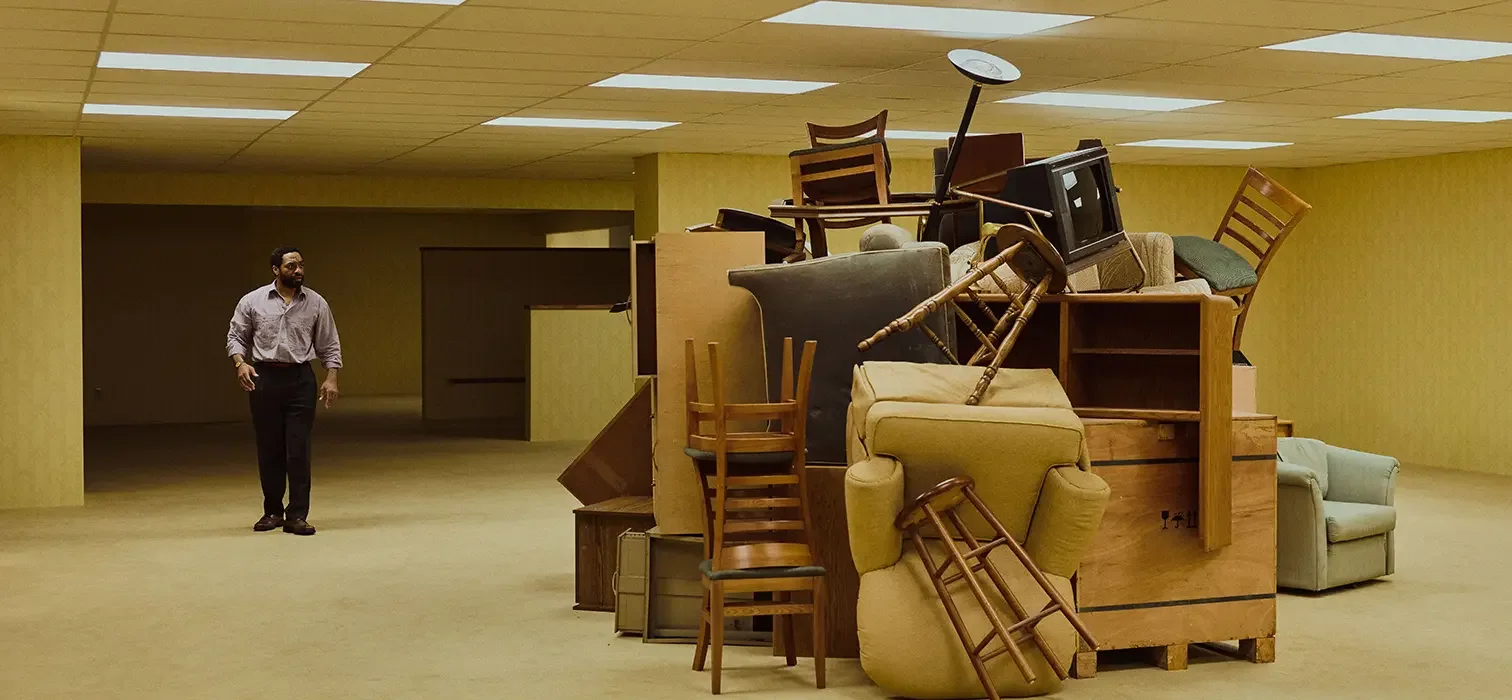
The most frightening thing about Backrooms is how little it needs. Beige walls. Fluorescent lights. Carpet. A corridor that seems familiar until you realize it should not continue that far. Kane Parsons understands that the concept works because the environment is almost normal.
Liminal horror survives the jump to a feature
Turning an internet-born idea into a full movie creates an obvious problem: explanation can kill mystery. The Backrooms are compelling because they resemble a half-remembered office, hotel or school assembled incorrectly by a dream. The more precisely you define that space, the less room remains for the viewer's brain to make it worse.
Parsons largely protects that quality. The production design is the star. Rooms connect with the logic of memory rather than architecture. Objects appear where they almost belong. Corners make you nervous before anything actually comes around them.
More than a YouTube concept stretched thin
Chiwetel Ejiofor and Renate Reinsve help give the feature human gravity, and Parsons proves surprisingly comfortable directing performers as well as spaces. That matters. A collection of beautifully unsettling corridors could sustain a short film; a feature needs people whose fear changes as they understand — or fail to understand — where they are.
I was most impressed when the film resisted the temptation to constantly show us something. Empty space is the monster for long stretches. The frame invites you to inspect doorways and distant corners until your own attention becomes exhausting.
Mystery versus mythology
The feature inevitably gives the concept more narrative structure than its most abstract versions. Some viewers will appreciate the added shape; others may feel that every answer removes a little oxygen from the nightmare. I fall somewhere in the middle. The movie is strongest when it lets architecture remain irrational.
The sound is almost as important as the architecture
The visual language gets most of the attention, but the film's soundscape does crucial work. Fluorescent hum, distant mechanical noise and the suggestion of activity behind a wall turn empty rooms into spaces that never feel truly empty. Silence is used less as absence than as a warning that the environment has changed.
That restraint is valuable because internet horror often becomes less frightening once a creature is clearly visible. Parsons understands that anticipation can be the event. A corridor that contains nothing can still be unbearable if the movie has trained you to distrust distance.
From viral image to sustained mood
The achievement is not simply reproducing the recognizable yellow rooms at feature length. It is finding variations without losing the banal quality that made the original concept disturbing. The spaces evolve, but they remain close enough to offices, schools, hotels and service corridors to trigger recognition.
Backrooms works whenever it makes familiarity unreliable. We know what a room is supposed to do. The horror begins when the room seems to know that too — and refuses.
Verdict
Backrooms is an unusually successful translation of internet horror because Parsons understands what should not be upgraded. The lights are still ugly. The walls are still boring. The emptiness is still the point. Give that emptiness enough time and, somehow, a beige corridor becomes more threatening than a room full of monsters.